Steam Locomotives of Victoria, AU
Alexandra
Alexandra Timber Tramway & Museum
 The Alexandra Timber Tramway & Museum has three 2-foot gauge steam
locomotives. They include:
The Alexandra Timber Tramway & Museum has three 2-foot gauge steam
locomotives. They include:
- Number 4 (pictured to the right), is an 0-6-0 Queensland Sugar locomotive built by Hudswell Clarke & Co. in 1925 (formerly displayed at Old Sandhurst Town, Bendigo). Since this picture was taken this locomotive has been moved to Strath Creek.
- Number 5, an operational 0-6-0T sugar mill locomotive built by John Fowler in 1909. Photo courtesy Rowan Millard.
- Number 7, an 0-6-0 Queensland Sugar locomotive built by Hudswell Clarke & Co. in 1915. As of 2005, it is undergoing a very slow restoration.

Ballarat
The town of Ballarat is about 60 miles (97 km) north west of Melbourne and is the home of the West Coast Railway and the Ballarat Workshops. There are two "workshops" in Ballarat. Ballarat East was once the VR locomotive depot and is where the West Coast Railway & Steamrail is now. Ballarat North (now privately owned) is the main workshop where D3 653 is on display. There is another workshop near the station, but I have no further info on it.Ballarat North Workshops
The Ballarat North Workshops was a VR shop, and also a locomotive building site.D3 653
 This locomotive is located on the front of the Ballarat Workshops. It is a class
"D3" 4-6-0 built by the Victorian Railways in 1908. If you look closely, you
will notice that the cylinders are angled upwards in front. To an Australian
this is probably not worth mentioning. However, this would be a rarity in
the U.S. where almost all steam locomotives were designed with the cylinders
parallel to the ground in-line with the drive axles of the locomotive.
This locomotive is located on the front of the Ballarat Workshops. It is a class
"D3" 4-6-0 built by the Victorian Railways in 1908. If you look closely, you
will notice that the cylinders are angled upwards in front. To an Australian
this is probably not worth mentioning. However, this would be a rarity in
the U.S. where almost all steam locomotives were designed with the cylinders
parallel to the ground in-line with the drive axles of the locomotive.
The reason why many Australian steam locomotives had angled cylinders
was to so that they would clear the commonly found high level platforms.
On large steam, clearance problems sometimes led to the use of three
cylinders of moderate size, in leiu of two big ones. The VR H class
4-8-4 and S class 4-6-2 and the NSWGR 57 and 58 class 4-8-2s are examples.
West Coast Railway
The West Coast Railway has their main yards in Ballarat. The West Coast Railway owns about 8 steam locomotives. They presently operating two of them in revenue service between Melbourne and Warnambool twice daily in each direction. The two operating locomotives are a large baltic/hudson R class and an 0-6-0 Y class. They run their R class on every Saturday morning on the revenue service. R711 has been equipped with diesel control and m.u. leads and is painted in WC livery (although not as bright as the diesels)!Turntable
 This is a north eastern view of the turntable at the West Coast Railway Ballarat
East shops. The green engine house is located on the left in this view. There
are at least four steam locomotives surrounding the turntable. Two of the
locomotives can be seen in the foreground of this photo. The silver cabless one
on the left is D3-688. It came second hand from the Mornington Railway
Preservation Society (east of Port Phillip Bay). The one in the center
foreground with the rusty boiler is D3-638. It has "Rosebud Picnic Park"
painted on the rusty boiler. It originally came from Peninsula Gardens, Jetty
Rd., Rosebud (east of Port Phillip Bay).
This is a north eastern view of the turntable at the West Coast Railway Ballarat
East shops. The green engine house is located on the left in this view. There
are at least four steam locomotives surrounding the turntable. Two of the
locomotives can be seen in the foreground of this photo. The silver cabless one
on the left is D3-688. It came second hand from the Mornington Railway
Preservation Society (east of Port Phillip Bay). The one in the center
foreground with the rusty boiler is D3-638. It has "Rosebud Picnic Park"
painted on the rusty boiler. It originally came from Peninsula Gardens, Jetty
Rd., Rosebud (east of Port Phillip Bay).
 This is a south western view of the turntable. In the background, you can see the overpass
from which the previous photo was taken. The same locomotives (as shown in the last
photo) are shown here. D3-638 is on the left. D3-688 is on the right.
This is a south western view of the turntable. In the background, you can see the overpass
from which the previous photo was taken. The same locomotives (as shown in the last
photo) are shown here. D3-638 is on the left. D3-688 is on the right.
D3 Class Number 638
 D3-638 has "Rosebud Picnic Park" painted on the rusty boiler. It originally came
from Peninsula Gardens, Jetty Rd., Rosebud (east of Port Phillip Bay). As you
can see the side rods have been removed from it.
D3-638 has "Rosebud Picnic Park" painted on the rusty boiler. It originally came
from Peninsula Gardens, Jetty Rd., Rosebud (east of Port Phillip Bay). As you
can see the side rods have been removed from it.
D3 Class Number 641
 D3-641 is painted black. It came from the Wotherspoon Reserve, Lawrence St.,
Beaufort (between Ballarat & Ararat (west of Ballarat)).
D3-641 is painted black. It came from the Wotherspoon Reserve, Lawrence St.,
Beaufort (between Ballarat & Ararat (west of Ballarat)).
J536

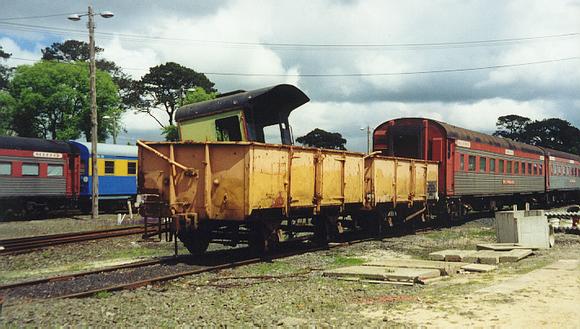
 This locomotive (J536) was built by Vulcan Foundry, England in 1954 (cn# 6082). It is
a 2-8-0 and was used for general traffic. I found it in three pieces
scattered throughout the yard. The boiler was in a shed. The cab was
stored in a gondola. The tender was stored on a track near the turntable.
This locomotive used to be on display in a park in Colac.
This locomotive (J536) was built by Vulcan Foundry, England in 1954 (cn# 6082). It is
a 2-8-0 and was used for general traffic. I found it in three pieces
scattered throughout the yard. The boiler was in a shed. The cab was
stored in a gondola. The tender was stored on a track near the turntable.
This locomotive used to be on display in a park in Colac.
D3 608
 This locomotive was displayed a short walk east of the turntable and shop
area. As you can see, the tender has been dismantled and it is missing its
side rods. This locomotive was previously on display in a park in Stawell.
I have heard a report that this locomotive was recently moved to either
Newport or Seymour. Can anyone confirm this?
This locomotive was displayed a short walk east of the turntable and shop
area. As you can see, the tender has been dismantled and it is missing its
side rods. This locomotive was previously on display in a park in Stawell.
I have heard a report that this locomotive was recently moved to either
Newport or Seymour. Can anyone confirm this?
Y112
 This is one of two operating steam locomotives of the West Coast Railway.
Y112 was built in 1889 by the Phoenix Foundry Company, Ballarat (cn# 238).
A quick glance at this locomotive will reveal that it has no cylinders!
Actually, it does have pistons and cylinders. They are located between
the wheels at the front of the locomotive. Y112 used to be displayed
somewhere in Ballarat until sometime in the 1970s.
This is one of two operating steam locomotives of the West Coast Railway.
Y112 was built in 1889 by the Phoenix Foundry Company, Ballarat (cn# 238).
A quick glance at this locomotive will reveal that it has no cylinders!
Actually, it does have pistons and cylinders. They are located between
the wheels at the front of the locomotive. Y112 used to be displayed
somewhere in Ballarat until sometime in the 1970s.
Boilers

 Two boilers are located in the yard. Drivers are located near one boiler
(the one with the saddle tank). I have to assume that they are both
parts of the same locomotive. This boiler is probably from the Bellarine
Peninsular Railway.
Two boilers are located in the yard. Drivers are located near one boiler
(the one with the saddle tank). I have to assume that they are both
parts of the same locomotive. This boiler is probably from the Bellarine
Peninsular Railway.
The other boiler is quite small. It is most likely a steam wagon
boiler (short length with cylinder on top). The make is most likely
Foden, made at Sandbach, Cheshire, UK because of the cylinder block
shape, with a curved taper above and below the horizontal valve chest
cover mountings on the sides. The different cylinder bores indicate
that it was a compound steam engine.
S312
 A few diesels are also in the yard area. This is one of four "S" class diesels
owned by the West Coast Railway. The three others (S300, S302, S311) are in
operating condition. S312 is awaiting restoration. S312 looks like an EMD-built
E-unit, however, it was built in 1960 by Clyde Engineering, Granville, NSW.
A few diesels are also in the yard area. This is one of four "S" class diesels
owned by the West Coast Railway. The three others (S300, S302, S311) are in
operating condition. S312 is awaiting restoration. S312 looks like an EMD-built
E-unit, however, it was built in 1960 by Clyde Engineering, Granville, NSW.
Links
- West Coast Railway (Peter Haworth's page)
- West Coast Railway (Buslines page)
Bendigo
On one of my visits to Bendigo in December 2004, I spotted this locomotive at the railway station. It was D3 619, a Baldwin 4-6-0. 619 has since been moved to Maldon.
Echuca
Echuca is about a three hour drive north of Melbourne. In the late 1800s, the town of Echuca was a major port on the Murray River. Today, the Red gum wharf serves as the centrepiece of an impressive museum -- the Port of Echuca. Located at the museum is an impressive collection of agricultural steam locomotives as well as a class A2 railway locomotive.Port of Echuca
 Once included in the museum's collection was this rare class A2 (4-6-0)
steam locomotive (number 996). It was built by the Victorian Railways in
1916. Notice the walschaerts valve gear. The locomotive had been a static
display in Echuca since 1968. However, in 2002 restoration efforts began
on this locomotive. Although the locomotive had been steamed up in recent
years, it has not been moved since it was brought into the museum area
and most moving parts were rusted tight. The West Coast Railway had plans
to move No. 996 to its workshops in Ballarat so that further restoration
efforts may continue. The boiler needed to be rebuilt so that it could
operate at full pressure. The intention was to have No. 996 operational
by 2004 so that it can be a part of the celebrations commemorating the
150th anniversary of railways in Victoria. However, some trackage rights
problems emerged which put all of the plans for this locomotive on hold.
In 2004 the locomotive made it as far as the Echuca Depot. It now sits
on a siding, unprotected from vandals and the elements. The photographs
I took in 2008 show the poor condition this locomotive was in. Since then
the locomotive has received new paint but it is still sitting unprotected
by the depot.
Once included in the museum's collection was this rare class A2 (4-6-0)
steam locomotive (number 996). It was built by the Victorian Railways in
1916. Notice the walschaerts valve gear. The locomotive had been a static
display in Echuca since 1968. However, in 2002 restoration efforts began
on this locomotive. Although the locomotive had been steamed up in recent
years, it has not been moved since it was brought into the museum area
and most moving parts were rusted tight. The West Coast Railway had plans
to move No. 996 to its workshops in Ballarat so that further restoration
efforts may continue. The boiler needed to be rebuilt so that it could
operate at full pressure. The intention was to have No. 996 operational
by 2004 so that it can be a part of the celebrations commemorating the
150th anniversary of railways in Victoria. However, some trackage rights
problems emerged which put all of the plans for this locomotive on hold.
In 2004 the locomotive made it as far as the Echuca Depot. It now sits
on a siding, unprotected from vandals and the elements. The photographs
I took in 2008 show the poor condition this locomotive was in. Since then
the locomotive has received new paint but it is still sitting unprotected
by the depot.
Links
- 996 (Dec 2010 Photo by Wes Barris)
- 996 (Dec 2008 Photo by Wes Barris)
- 996 (Dec 2008 Photo by Wes Barris)
- 996 (Dec 2008 Photo by Wes Barris)
- Port of Echuca
- A2 Class Locomotives (John Hurst's Web Site)
- Paddlesteamer Emmylou


Healesville
Yarra Valley Tourist Railway
 Healesville is a "touristy" town with several
attractions including the Healesville Santuary and the Yarra Valley Tourist
Railway. The railway was closed when I visited but I was able to snap
a shot of their two steam locomotives. Both are VR J class 2-8-0s from
the Vulcan Foundry and are undergoing restoration work. Their numbers are
J 516 and J 541. J 516 was once displayed in a park in Greensborough. J
541 is privately owned. In 2005 J 541 was restored to operating condition
at the Puffing Billy Railway.
Healesville is a "touristy" town with several
attractions including the Healesville Santuary and the Yarra Valley Tourist
Railway. The railway was closed when I visited but I was able to snap
a shot of their two steam locomotives. Both are VR J class 2-8-0s from
the Vulcan Foundry and are undergoing restoration work. Their numbers are
J 516 and J 541. J 516 was once displayed in a park in Greensborough. J
541 is privately owned. In 2005 J 541 was restored to operating condition
at the Puffing Billy Railway.
Koondrook
 In the center of the small town of Koondrook, sits this display of the
Kerang & Koondrook Tramway. This is a replica built in 1984 at Hume
Colville. The original was built in Shrewsbury, England. It was imported
to Australia in 1929, withdrawn from service in 1941, and scrapped in 1952.
The locomotive number is 5766 and its wheel arrangment is classified as
"4wVBT" (4 wheeled, vertical boilered, tank engine).
In the center of the small town of Koondrook, sits this display of the
Kerang & Koondrook Tramway. This is a replica built in 1984 at Hume
Colville. The original was built in Shrewsbury, England. It was imported
to Australia in 1929, withdrawn from service in 1941, and scrapped in 1952.
The locomotive number is 5766 and its wheel arrangment is classified as
"4wVBT" (4 wheeled, vertical boilered, tank engine).
Maldon
Maldon is a small scenic town that has a number of tourist attractions. These attractions include (but are not limited to) wineries, arts & craft shops, antique shops, many cottages and cabins, many cafes and restaurants and a tourist railway.Victorian Goldfields Railway
The Victorian Goldfields Railway is headquartered in Maldon while the maintenance facilities are located in Castlemaine. At least, this is what I gather having visited Maldon and not Castlemaine. I understand that Castlemaine is on the mainline while Maldon is at the end of the branch.The Castlemaine & Maldon Railway Preservation Society owns the rolling stock. The name "Victorian Goldfields Railway" is the marketing name held by the Society.
K160
 This is one of Castlemaine & Maldon Railway's operational steam locomotives.
It is a class K 2-8-0 built in 1940 by the Victorian Railways. It was
parked near the turntable (seen in the foreground). K160 is operational
but in very poor condition.
This is one of Castlemaine & Maldon Railway's operational steam locomotives.
It is a class K 2-8-0 built in 1940 by the Victorian Railways. It was
parked near the turntable (seen in the foreground). K160 is operational
but in very poor condition.
- K Class Locomotives (John Hurst's Web Site)
K157
 K157 is a 2-8-0 built by the Victorian Railways Newport Workshops in 1940. She
was one of 53 "K" series locomotives and was built the same year as the other
VGR K-class, K160. She was used on most of the VR network. K157 was retired in
the early 1970s after finishing her career as a shunting engine at the Ballarat
workshops. She once hauled a commisioners train to Picola. She was purchased
in 1983 by the VGR and has remained in storage at Maldon as seen here since
1988. Although restoration is in this locomotive's future, it is a long term
objective.
K157 is a 2-8-0 built by the Victorian Railways Newport Workshops in 1940. She
was one of 53 "K" series locomotives and was built the same year as the other
VGR K-class, K160. She was used on most of the VR network. K157 was retired in
the early 1970s after finishing her career as a shunting engine at the Ballarat
workshops. She once hauled a commisioners train to Picola. She was purchased
in 1983 by the VGR and has remained in storage at Maldon as seen here since
1988. Although restoration is in this locomotive's future, it is a long term
objective.
E371
 371 is an E class 0-6-2 tank locomotive. It was built in 1892 (cn# 13) by
David Munro & Co. as an E class 2-4-2T. It is in unrestorable condition.
The boiler is condemmed, most stays are cracked, and the frame has cracks.
It is currently used as a static display.
371 is an E class 0-6-2 tank locomotive. It was built in 1892 (cn# 13) by
David Munro & Co. as an E class 2-4-2T. It is in unrestorable condition.
The boiler is condemmed, most stays are cracked, and the frame has cracks.
It is currently used as a static display.
Other Victorian Goldfields Railway Steam Locomotives
- Steam locomotive D3 646 (a 4-6-0) built in 1905 by the Victorian Railways was obtained from static display at Maryborough. It will eventually be restored to operating condition.
- Steam Locomotive J549 (a 2-8-0) was one of the last steam locomotives in main line service. It is a modern oil burner built in 1954 (cn# 6095) by the Vulcan Foundry, England. It was returned to service on the Victorian Goldfields Railway in 1992. In 2008 it received a major overhaul including new tyres on all driving and pony truck wheels, new axle boxes, springs and brake rigging, new smoke box, new super heater elements, and are-building of its air compressor.
Links
- Victorian Goldfields Railway (official site)
- Castlemaine & Maldon Railway Preservation Society
- Official Visitor'S Guide To Mount Alexander Shire
- J Class Locomotives (John Hurst's Web Site)
- K Class Locomotives (John Hurst's Web Site)
Melbourne
Puffing Billy
I was unable to visit Puffing Billy during my trip. However, because it is an important steam railway attraction in the Melbourne area, I have included a couple links to information about it.Links
- Puffing Billy Railway
- Puffing Billy Photographs (John Hurst's Web Site)
Williamstown Railway Museum

 The Australian Railway Historical Society (Victorian Division) Railway Museum in
Williamstown boasts an impressive collection of steam locomotives. The museum
is located on Melbourne Road in Williamstown (south of Melbourne).
The Australian Railway Historical Society (Victorian Division) Railway Museum in
Williamstown boasts an impressive collection of steam locomotives. The museum
is located on Melbourne Road in Williamstown (south of Melbourne).
R704

 This locomotive is an R class Hudson number 704. It is similar to
R711 which operates at the West Coast Railway in Ballarat. It was
built by the North British Locomotive Co. in Glasgow in 1950-51 (cn# 26994).
This locomotive is an R class Hudson number 704. It is similar to
R711 which operates at the West Coast Railway in Ballarat. It was
built by the North British Locomotive Co. in Glasgow in 1950-51 (cn# 26994).
The photo on the right is a postcard I picked up at the museum during
my visit. From the postcard I got this information: R704 is a modern
4-6-4 built in 1950 by the North British Locomotive Company and on
display at Glasbow in the Industrial Power Section of the Festival of
Britain in 1951. It was put into service on the Victoria Division in
1952 and removed from service in 1967 and relocated to the
Williamstown Railway Museum.
N432 and K165
 N432 is a 2-8-2 built by the Victorian Railways Newport Workshops in 1951. It
was originally built as a coal burner then converted to burn oil in 1954. It
was retired in 1966 and placed in the museum in 1968. It is currently painted
in the colours of sister locomotive N 430 when it was used to pull the
Centenary Jubilee Train in 1951.
N432 is a 2-8-2 built by the Victorian Railways Newport Workshops in 1951. It
was originally built as a coal burner then converted to burn oil in 1954. It
was retired in 1966 and placed in the museum in 1968. It is currently painted
in the colours of sister locomotive N 430 when it was used to pull the
Centenary Jubilee Train in 1951.
K165 is a 2-8-0 built by the Victorian Railways Newport Workshops between 1940 and 1943. 53 "K" series locomotive were built and many survive today.
- K Class Locomotives (John Hurst's Web Site)
D268
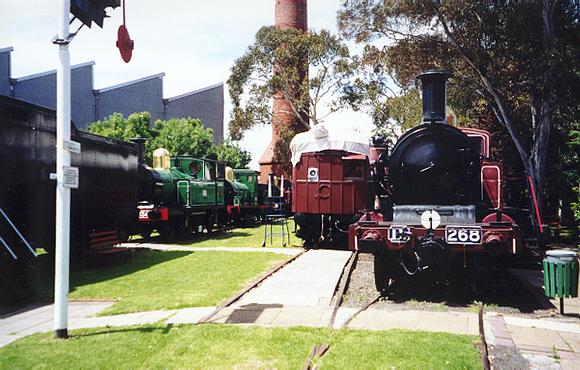 This is a D4 class 4-6-2 tank engine. It was built in 1910 by the Victorian Railways.
G33


 This is a 3'-6" gauge 4-8-2+2-8-4 Australian Standard Garratt. It is the only
surviving Australian Standard Garratt (ASG). The ASG was a West Australian (Mills)
design intended as a wartime standard for mass production. It was built at
the V.R. Newport Workshops in 1945. The Australian Portland Cement Company
bought the locomotive and used it from 1946 to 1966 on their railway near
Geelong. In 1968 it was donated and moved to the Williamstown Railway Museum.
This is a 3'-6" gauge 4-8-2+2-8-4 Australian Standard Garratt. It is the only
surviving Australian Standard Garratt (ASG). The ASG was a West Australian (Mills)
design intended as a wartime standard for mass production. It was built at
the V.R. Newport Workshops in 1945. The Australian Portland Cement Company
bought the locomotive and used it from 1946 to 1966 on their railway near
Geelong. In 1968 it was donated and moved to the Williamstown Railway Museum.
Links
Steamrail Victoria
Steamrail Victoria is an all-volunteer organization that has four operational steam locos (2 K-class, a D3 and an R), several operational diesels and several steam and diesel locos either under various stages of restoration or storage. They run charters and fan trips on the 5'3" Victorian main line. They are located on the Newport Workshops site opposite from the Australian Railway Historical Society.Links
Numurkah

 K181 is displayed in a park in Numurkah. K181 was built in 1943.
Seymour
Victoria Railways Class D3 4-6-0 Number 684
 Victorial Railways number 684 is displayed in a park in Seymour. 684 is a class D3 4-6-0 built in 1913
by Walkers Ltd.
Victorial Railways number 684 is displayed in a park in Seymour. 684 is a class D3 4-6-0 built in 1913
by Walkers Ltd.
Seymour Railway Heritage Center
The Seymour Railway Heritage Center is also located in town. During my visit I was able to find the center, howerver, it was closed and I have to assume that the steam locomotives were stored inside. The locomotives kept by the center include a couple of 2-8-0s: J-512 and J-515 both built in 1953 by the Vulcan Foundry, and a K class 2-8-0 number K176. J-512 was once displayed in Alexandra and is currently undergoing restoration. J-515 is operational and has been moved to Maldon.Swan Hill
Pioneer Settlement & Museum
 Victorial Rails number 640 is displayed in a park in the Pioneer Settlement & Museum in Swan Hill.
640 is a class D3 4-6-0 built in 1914 Thompsons Engineering in Castlemaine.
Victorial Rails number 640 is displayed in a park in the Pioneer Settlement & Museum in Swan Hill.
640 is a class D3 4-6-0 built in 1914 Thompsons Engineering in Castlemaine.