Data from Degolyer, Volume 19, p. 239 and Volume 28, p. 72. See also Margaret Hoffman, "1895 Baldwin locomotive from historic S.D. Warren Paper Mill restored to steam operation", Wiscasset Newspaper (29 August 2019), archived at []; and Dick Forrest, engineer in charge, "Historic locomotives receive 'Full Steam Ahead' following annual state inspection" on the Boothbay, ME Railway Village Museum, (nd) archived at [] last accessed 6 July 2024. Works numbers were 14283 in April 1895 and 14522 in November and 25792 in June 1905.
The presence of this locomotive in Locobase owes a lot to the discovery of Margaret Hoffman's 2019 news story celebrating the restoration of the #2, one of two industrial saddle tanks delivered to SD Warren in 1895. S D Warren's Cumberland Mills paper mill "was the largest paper mill in the world" at the time, wrote Hoffman. 30 miles of track supported mill operations.
(A duplicate bearing #3 arrived in 1905; it was destroyed during a trestle collapse and scrapped in 1931.)
Locobase then looked up the specification page and found a wealth of information describing the conditions under which the pair would work. A long, neatly written note from the buyer concerns the necessary constraints on size: "The loco. should not be more than 5 ft in width & the only question should be whether with its length swivelling as it does on so short a wheel base, the ends might not interfere with the platforms. The largest car is a box car 5' 3" wide & about 18 ft long, but we are not at present planning to handle these cars, but only show you what must be provided in the way of clearance."
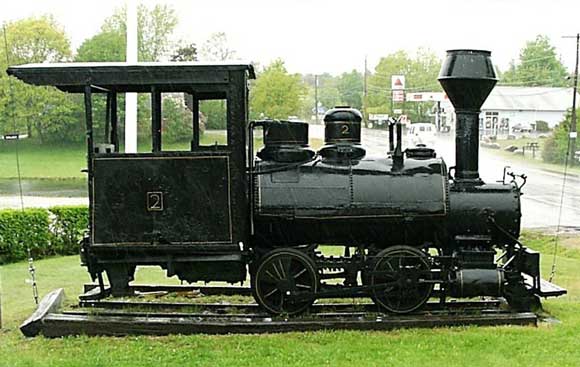
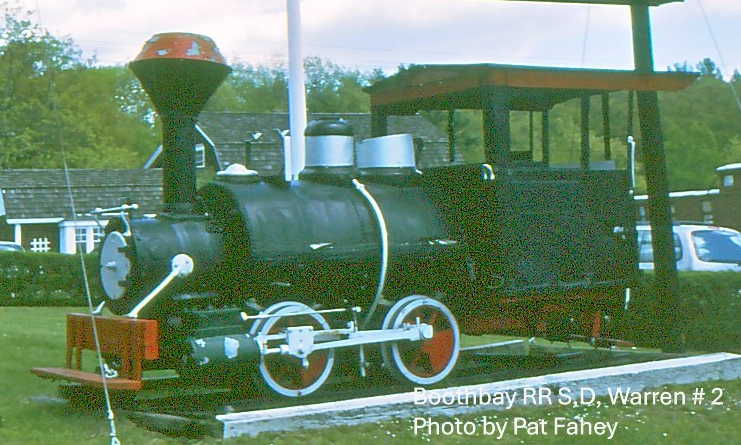
The builder's photo show a stubby locomotive with large cab, steam dome just ahead of the cab and the sand dome just ahead on the boiler over the space between the wheels and trailing sand lines toward each driver. A note in both the 1895 and 1905 specs require that a separate pipe carry the cylinderrs' exhaust to the top of the stack. Another note in the 1905 spec, however, further explained that it was "to go free alongside engine." (An illegibile word before "togo free" appears to read "forward" or "backward."
Then there's the extremely light 25 lb/yard (12.5 kg/metre) rail, 4.7% ruling grade over a 250 foot (76.2 m) stretch, and 30-ft radius curves.
About the quality of the Baldwin product, Hoffman refers to the template system: "Baldwin had developed clever ways to construct different locomotives to do different jobs, using a core of standard Baldwin parts. This kept construction costs low and delivery times fast, just what was needed in Maine."
She adds: "Although Baldwin engines were economical, they proved to be of high quality in both workmanship and material. Most of the Baldwin locomotives on the narrow-gauge railroads in Maine, were rebuilt over and over again during their long service lives, proving their value and ruggedness."
Supplanted by conveyor systems and diesels in the 1930s and 1940s, the 1 & 2 enjoyed a brief revival when parts for the conveyor proved hard to come by during World War II.
Once finally out of service, the #1 went on static display on Thorndike Hill and #2 under on a sign on Rte 27. In 2009, a routine inspection of the 2's cylinders showed they'd been preserved in excellent condition. This discovery sparked a decade-long restoration effort that put the 2 in tourist service in 2019.
| Principal Dimensions by Steve Llanso of Middle Run Media | |
|---|---|
| Class | 1 |
| Locobase ID | 16672 |
| Railroad | S D Warren |
| Country | USA |
| Whyte | 0-4-0ST |
| Number in Class | 3 |
| Road Numbers | 1-2, 3 |
| Gauge | 2' |
| Number Built | 3 |
| Builder | Burnham, Williams & Co |
| Year | 1895 |
| Valve Gear | Stephenson |
| Locomotive Length and Weight | |
| Driver Wheelbase (ft / m) | 3.83 / 1.17 |
| Engine Wheelbase (ft / m) | 3.83 / 1.17 |
| Ratio of driving wheelbase to overall engine wheelbase | 1 |
| Overall Wheelbase (engine & tender) (ft / m) | 3.83 / 1.17 |
| Axle Loading (Maximum Weight per Axle) (lbs / kg) | |
| Weight on Drivers (lbs / kg) | 14,000 / 6350 |
| Engine Weight (lbs / kg) | 14,000 / 6350 |
| Tender Loaded Weight (lbs / kg) | |
| Total Engine and Tender Weight (lbs / kg) | |
| Tender Water Capacity (gals / ML) | |
| Tender Fuel Capacity (oil/coal) (gals/tons / Liters/MT) | |
| Minimum weight of rail (calculated) (lb/yd / kg/m) | 12 / 6 |
| Geometry Relating to Tractive Effort | |
| Driver Diameter (in / mm) | 26 / 660 |
| Boiler Pressure (psi / kPa) | 150 / 1030 |
| High Pressure Cylinders (dia x stroke) (in / mm) | 7" x 12" / 178x305 |
| Tractive Effort (lbs / kg) | 2883 / 1307.71 |
| Factor of Adhesion (Weight on Drivers/Tractive Effort) | 4.86 |
| Heating Ability | |
| Tubes (number - dia) (in / mm) | 46 - 1.5" / 38 |
| Flues (number - dia) (in / mm) | |
| Flue/Tube length (ft / m) | 6.56 / 2 |
| Firebox Area (sq ft / m2) | 16.21 / 1.51 |
| Grate Area (sq ft / m2) | 3.70 / 0.34 |
| Evaporative Heating Surface (sq ft / m2) | 133 / 12.36 |
| Superheating Surface (sq ft / m2) | |
| Combined Heating Surface (sq ft / m2) | 133 / 12.36 |
| Evaporative Heating Surface/Cylinder Volume | 250.94 |
| Computations Relating to Power Output (More Information) | |
| Robert LeMassena's Power Computation | 555 |
| Same as above plus superheater percentage | 555 |
| Same as above but substitute firebox area for grate area | 2432 |
| Power L1 | 2625 |
| Power MT | 826.73 |